Celebrities and the Media Shouldn’t Sneer at Coronavirus Lockdown Protesters

polspphotos674743
(Keiko Hiromi/Polaris/Newscom)
By Robby Soave

The gatherings are ill-advised but understandable given the harms of government-enforced shutdowns.

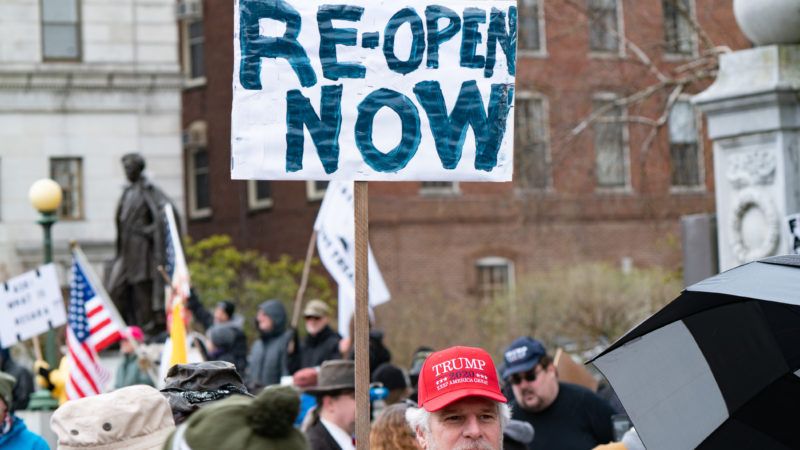
In their desperation to get back to work, some Americans are taking to the streets to demand that the government end the quarantine. Comedian Patton Oswalt is unsympathetic.

“Anne Frank spent 2 years hiding in an attic and we’ve been home for just over a month with Netflix, food delivery & video games and there are people risking viral death by storming state capital buildings & screaming, ‘Open Fuddruckers!'” he tweeted on Saturday.

This is hardly Oswalt’s first display of smug liberal condescension: His tweetdenouncing Covington Catholic High School student Nick Sandmann as a “leering, privileged little shit” was one of the most vile celebrity attacks on the wrongly maligned teenager.

It may be trivially simple for the Emmy Award-winning comic—and voice of Remy in Pixar’s Ratatouille—to stay at home, watch Netflix, order carry-out, and play video games for a few weeks. (Writer and podcaster Bridget Phetasy compared Oswalt to Marie Antoinette’s apocryphal indifference toward the hungry masses, tweeting: “Let them eat kale!”) But many auto mechanics, coffee baristas, and small business owners can’t afford this so easily. They are watching their financial situations become more and more precarious with each day that extreme social distancing continues. Oswalt suggested that the uncultured rubes are crazy to want Fuddruckers to reopen; people whose livelihoods depend upon places like Fuddruckers might see things differently.

That’s why it’s important for those criticizing misguided protesting efforts—including media figures who increasingly appear to be taking the view that you would have to be a deranged right-winger to want social distancing to end—not to resort to sneering at the less fortunate. (For example: A guest on MSNBC recently called the protesters, “the Fox News Nazi confederate death cult rump of the Republican Party.”) These are terrifying times, and the prospect of hundreds of thousands of deaths means there is very good reason for policymakers to proceed cautiously with reopening. But both federal and state governments must consider the long-term practicality of their coronavirus prevention plans, including whether people will be willing to obey stay-at-home orders for much longer.

While these efforts to slow the spread of COVID-19 remain broadly popular, some Americans are understandably growing frustrated. Protests have cropped up in several states—most notably Michigan, where opposition to the draconian quarantine dictatesof Gov. Gretchen Whitmer (D–Mich.) culminated in a drive-through protest of the state capitol last week. Many of the protesters did indeed maintain social distancing, stayed in their cars, or wore masks, though some of the attendees—zanier right-wing types—did not.

Political protests, be they left-leaning or right-leaning, always invite an eclectic crowd: from concerned citizens motivated by legitimate frustrations to professional activists desperate to attach a pro- or anti-Trump spin to seemingly any cause. Their tactics, goals, and organizational structure often attract well-deserved criticism: Some of the lockdown protests, for instance, seem to be generically pro-Trump in character, disconnected from the reality that thus far President Donald Trump has supported the shutdowns at every critical juncture. Indeed, it’s quite odd to hear protesters chanting “Fire Fauci” while waving MAGA signs: Trump has praised Dr. Anthony Fauci incessantly and never fails to heed his advice, the media’s attempt to create a narrativeof mounting tension between the two notwithstanding.

But there are legitimate grievances for protesters to air. Whitmer’s stay-at-home orders were, as Reason‘s Billy Binion put it, a “hot mess,” prohibiting travel between residences (even to relatively uninhabited areas), buying gardening supplies, and motorboats (but not boats without motors). Authorities in New York City have called on people to report each other for failing to abide by the most stringent social distancing measures. People have been stopped, shamed, and arrested for merely going outdoors. Voluntary compliance with social distancing has been remarkable, but forcibly constraining every last person has diminishing returns, and is not a good use of government resources.

That does not mean the quarantine protesters are, as conservative pundit Stephen Moore put it, “modern-day Rosa Parks.” But some of them are justifiably upset, and their frustration should be neither mocked nor ignored.
Physicians Should Be Allowed To Practice Across State Lines—and Not Just During a Pandemic

Telemedicine
By Vittorio Nastasi

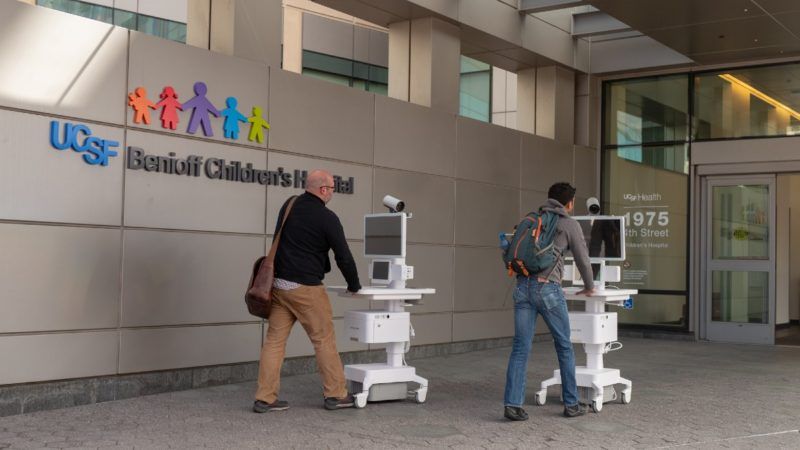
The COVID-19 pandemic is straining all the country’s health care resources right now—including the supply of physicians. In response, nearly all 50 states are temporarily suspending regulations to allow physicians to practice across state lines and to encourage the use of telemedicine, which lets patients interact with doctors remotely via audio or video. While these measures will alleviate some of the pressures caused by the coronavirus, physician shortages won’t go away after the virus subsides. 

Medical professionals are typically licensed on a state-by-state basis, so a doctor licensed in one state can’t practice in another without receiving an additional license. The patchwork of licensing requirements across states is a major obstacle to the use of telemedicine because physicians are generally only permitted to provide telemedicine services to patients in states where they are licensed. 

States are recognizing the cost of these onerous regulations in light of the current crisis. Over the past few weeks, governors and medical boards in every state except for Alaska, Arkansas, and Minnesota have temporarily suspended their licensing rules to allow out-of-state physicians to work in their state. Most of them have also waivedrestrictions on the use of telemedicine across state lines. Taken together, these actions will help ensure patients have adequate access to care.  

Some states are in greater need of physicians than others. On average, there are roughly 263 physicians per 100,000 people in the United States. But in Massachusetts, there are 449 physicians compared to just 191 in Mississippi. Moreover, the number of COVID-19 cases is expected to peak at different times in each state, so the peak demand for health care providers will vary. Allowing physicians to practice across state lines grants them flexibility to help where they are needed most.

Eliminating barriers to the use of telemedicine will also help contain the coronavirus’s spread. Most people infected with COVID-19 don’t require hospitalization but may still need to seek medical advice; telemedicine enables them to do so without risk of spreading the virus further. At the same time, patients who do not have COVID-19 symptoms but have another medical problem requiring them to consult with a physician or specialist will be able to receive some amount of care without risking exposure. 

Beyond the current crisis, telemedicine has the potential to connect patients with specialists across the country. Telemedicine may also reduce inefficiencies that result from schedule gaps, unexpected appointment cancellations, and the uneven geographic distribution of physicians. 

A growing, aging population is expected to generate a national shortage of nearly 220,000 physicians by 2032. As with the current distribution of physicians, shortages will not be evenly distributed across states. Regional projections from the Department of Health and Human Services (HHS) indicate that the Southeast will have a shortage of approximately 13,860 primary care physicians as early as 2025, while the Northeast will have a surplus of around 810 physicians. Telemedicine offers a solution, but states will need to reform their licensing laws for the technology to reach its full potential.

One way for states to reduce barriers for out-of-state physicians is to join the Interstate Medical Licensure Compact (IMLC), an agreement between 29 states and the District of Columbia that allows physicians to more easily receive licensure in each of the member states. The licensing process is expedited through information-sharing among compact member states. Physicians receive a “letter of qualification” from their home state, or State of Principal Licensure (SPL), that is used to verify their qualifications for licensure in other member states. 

This approach has limitations because its efficacy is dependent on widespread adoption and implementation. Of the 29 states that have passed IMLC legislation, only 24 are currently acting as SPLs and issuing licenses to physicians from other states. Oklahoma and Vermont are issuing licenses to out-of-state physicians, but are not acting as SPLs. Georgia, Kentucky, and Pennsylvania have passed IMLC legislation but have unfortunately delayed implementation.   

Alternatively, states can simply recognize licenses from other states—something they are already doing to address the current crisis. Last year, Arizona became the first state to pass universal license recognition for most occupations including physicians. However, the reforms only apply to people relocating to Arizona, not to out-of-state telemedicine providers. Meanwhile, Florida recently created a registration process that allows out-of-state providers to practice telemedicine but does not allow them to provide in-person care without first obtaining a Florida license. Combining these approaches would go a long way toward addressing current and future shortages. 

Physician shortages resulting from COVID-19 are only highlighting the need for greater fluidity in the labor market for medical professionals. Lawmakers are wisely suspending regulations that prevent physicians from practicing telemedicine across state lines, but permanent reform is necessary to address the looming shortage.

Trump Vows to Cut Off U.S. Funding to the World Health Organization

74681945_m
By Brian Doherty

President Donald Trump said in a press briefing today that he intends to halt U.S. funding for the World Health Organization (WHO), explaining that “we have deep concerns whether America’s generosity has been put to the best use possible,” particularly given how it has handled the COVID-19 pandemic.

“The reality is that the WHO failed to adequately obtain, vet, and share information in a timely and transparent fashion,” he said.

The U.S. was on the hook to contribute 22 percent of the organization’s budget for the 2020-21 fiscal year, according to WHO’s own records—around $236 million. (For the same period, China contributed around $129 million.)

The WHO had long been criticized, rightly, for being more about bureaucracy and behavior control than being directly helpful in infectious disease control. International action to prevent the spread of diseases is not really what it does. In the wake of the last decade’s Ebola crisis, scholars noted the organization’s fecklessness in bettering actual public health, as opposed to issuing pronouncements about individual or institutional behavior.

In the current pandemic, the WHO was slow to do its minimal job of spreading accurate information about the disease. Indeed, it spread actively inaccurate info, acting as a conduit for Chinese disinformation. So it isn’t shocking that the president might prefer to not reward them from U.S. funds.

It is uncertain how Trump’s declaration will play out in real-world politics. It is certainly possible that his comment will be ignored by the time the relevant budget decisions are made. But his concerns about the WHO’s usefulness in this world crisis are widely shared, and the Senate Homeland Security Committee has launched its own investigation into the WHO’s COVID-19 response as well. So perhaps something will come of it.

2 Decades of Dubious Surveillance Will Make It Much Harder To Track COVID-19 Now

edwardsnowden_1161x653
By Scott Shackford

Would you tell an app on your phone if you tested positive for COVID-19 so that people who had been in close contact with you could be informed?

For many Americans, the answer would be yes, many emphatically so. But deep suspicion about who might see that information and how that information might be used to suppress civil liberties will push thousands, maybe even tens of thousands, of Americans to refuse.

Their refusal to participate might make it much harder to track the spread of the coronavirus and protect people from exposure. That’s unfortunate, but that deep suspicion of how the government uses our private data from our phones and computers is justified by an entire post-9/11 regime of domestic surveillance that far too many government officials continue to defend.

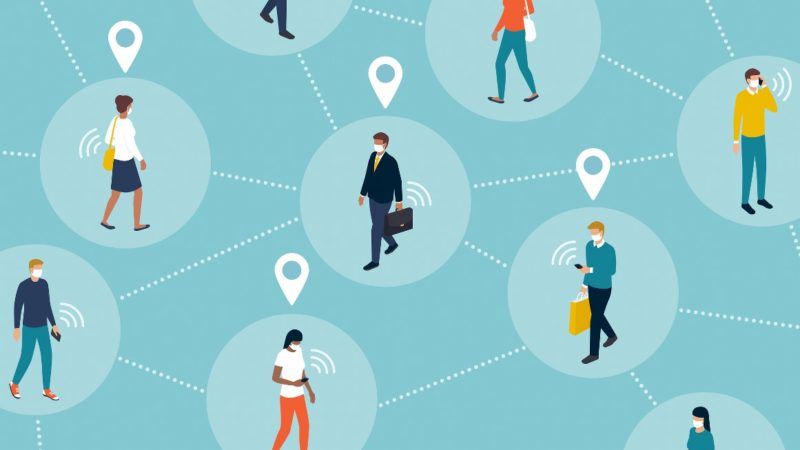
Andrea O’Sullivan explained here at Reason how location technology on our phones could be used to help trace COVID-19 infections and how apps are playing an important role at stopping the spread in South Korea and China. Apple and Google are partnering up to host apps that will allow individuals around the world to participate. People who discover they’ve been infected with the coronavirus can inform the app, and the app will inform others who have come into close contact with them recently, letting them know they may have been exposed so that they can take proper precautions and self-isolate.

The way Apple and Google are approaching these tools is admirable, at least on paper. Participation will be voluntary. The tools won’t actually collect identifiable information on location data. People who test positive will not be identified to Google or Apple or transmitted to health authorities. (Google explains how the location tracing will work here.)

But there’s a lot of mistrust—and I don’t just mean mistrust of Google and Apple. There’s mistrust of governments, both authoritarian and democratic, who might be able to track citizens and collect data via phones. China is already doing this with its citizens. Let’s not pretend that this is simply a tool of authoritarian regimes. After the passage of the PATRIOT Act, the National Security Agency (NSA) secretly implemented the collection and storage of mass amounts of Americans’ phone and internet metadata, without a warrant or any real justification other than to search through it for potential terrorist plotting.

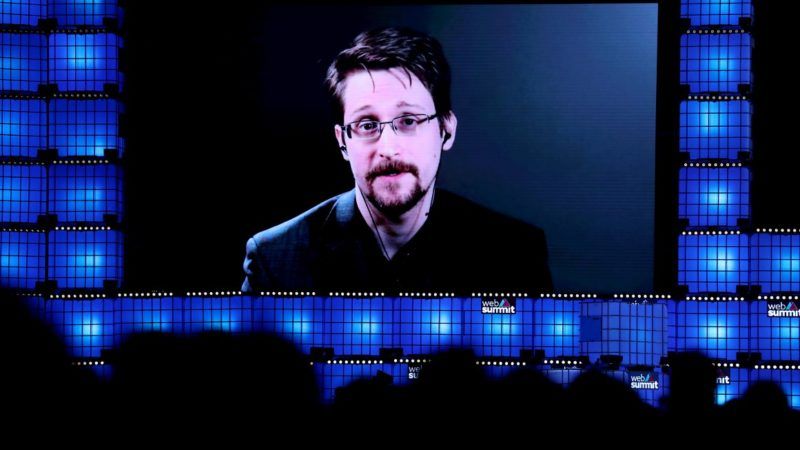
Edward Snowden revealed the extent of this surveillance to Americans almost seven years ago, and at the time, a significant number of bipartisan political leaders insisted that this surveillance, despite violating the Fourth Amendment rights of all Americans, was needed to protect us from violent terrorism. It was not. As the years went by, it became clear that this mass surveillance was not making us safer, nor was it an effective tool for fighting terrorism. The USA Freedom Act reformed the system to restrict how the data could be collected and accessed but also brought it out from the shadows and made it official policy. (The USA Freedom Act expired in March since Congress did not reach a compromise over renewing it as attention turned to the pandemic, a mostly unnoticed casualty of COVID-19.)

Now, Snowden warns that the same governments that used the fear of terrorism to justify massive domestic surveillance may do the same for the coronavirus. People may recall that Snowden was initially dismissed as a crank by a lot of people until the government was forced to acknowledge that much of what he’d revealed was actually true.

We already see examples of law enforcement agencies at home and abroad abusing their surveillance tools to try to exert authority over citizens instead of helping them. Drones can be a boon to police when searching for lost people or scoping out dangerous situations. But in England, one police department used them to snoop onand attempt to shame citizens who had gone to a park to exercise and be outdoors (none of these citizens appeared to be violating social distancing rules). In Kentucky, police are using license plate readers to force compliance with self-quarantine orders. This surveillance is not being used to collect information to track the coronavirus. It’s being used to control people.

And so, if thousands of Americans (or Brits) refuse to assist public health agencies by opting into these apps, don’t blame them. Blame the government officials who have reliably used every single crisis for the past two decades to insist they need to have access to more and more information about our private lives. Will Apple and Google even be able to keep their promises that the government can’t access this private data, given that both politicians and the Department of Justice are trying to destroy encryption to make secret surveillance easier?

In all likelihood, I will download and participate in this app system when it’s introduced. I live in Los Angeles in a neighborhood with a lot of families with older residents who are especially likely to have severe cases if they’re exposed. But I wouldn’t judge anybody who refuses to participate. The government already cried wolf. Now that they really need us to trust that they truly need to know where we are, they’ve already trained us not to believe them.

We Can Track COVID-19’s Spread Without Violating Privacy

coronatracking_1161x653
By Andrea O’Sullivan

As the weeks of quarantine and social distancing drag on, many justifiably wonder when life can start getting back to normal. It’s not just cabin fever: Shutdowns mean real economic pain for millions of Americans, to say nothing of the mental and sometimes physical tolls of isolation. Getting Americans back to work is a public health concern, too.

We simply can’t expect people to stay cooped up for a year or longer, as some have suggested. And there are reasons for cautious optimism anyway: Although the data are hazy and ever-changing, decreasing rates of infection and death in parts of Asia, Europe, and the United States suggest that non-pharmaceutical interventions like better hygiene and social distancing have indeed made COVID-19 more manageable.

But we can’t just blindly open the gates and infect vulnerable populations that overwhelm the health care supply, either. Not only could that scenario increase the threats to health care workers and first responders, it could compel people to stay home more often anyway for fear of the virus, which would create the same economic problem that the re-opening was trying to fix.

The challenge is how to intelligently get closer to normal without letting COVID-19 transmissions get out of control. The specific pathway to open the United States back up is still unclear, but we’ll probably need at least three things to do so: near-universal mask-wearing, targeted mass testing, and a virus-tracing surveillance system.

The first two conditions should find few dissenters. We should make sure that our essential workers have enough personal protective equipment, but in the meantime, pandemic civilians can dramatically cut down on the viral spread by simply wearing a good homemade mask. Strategically testing to determine where the virus has spread is similarly a no-brainer, since it allows us to separate virus-free “green zones” that can be loosened up from beleaguered “red zones” that need to continue control measures.

But when you start talking about “surveillance,” many may understandably chafe. In our age, the word is synonymous with rights-defying government snooping, and so it immediately smacks of a conspiracy to spy.

Yet surveillance has a more innocuous meaning in the context of public health. The official definition is the “ongoing, systematic collection, analysis, and interpretation of health-related data essential to planning, implementation, and evaluation of public health practice, closely integrated with the timely dissemination of these data to those responsible for prevention and control.” Less spying on your Facebook messages to see whether you’re up to no good, more looking at seasonal influenza trends to determine which vaccine to recommend this year.

For the COVID-19 pandemic, public health surveillance mostly means contact tracing. When an infectious disease is in a manageable state, outbreaks can be contained by identifying who is sick and “tracing” the other people with whom they have made “contact.” Those sick patients can then be surgically quarantined to stop the spread while their contacts are monitored to see whether they too develop symptoms. Meanwhile, those who are healthy or who have immunities can continue on mostly unimpeded.

In the past, contact tracing took a lot of public health officials’ shoe leather. To beat back the 2014-2016 Ebola outbreak in Africa, for instance, officials asked patients to physically write out a list of people they remembered seeing recently. Faulty memory and insufficient resources meant that some cases could go undiscovered, and public health surveillance was not as effective as it might have been.

Today, we have technology to help. We can devise applications and wearables to help us see how diseases are spreading by monitoring with whom we come into contact. If one of us falls sick, we can review whom we’ve been around to hopefully catch new outbreaks before they spiral out of control.

And this is where the typical definition of surveillance can rear its ugly head. Many worry that such technology-enabled contact tracing can indeed become a tool for state control. After all, what government wouldn’t want to get its greedy paws on such a God View of society? (Setting aside the question of whether it already has one.)

The governments of South Korea and China have rolled out mandatory apps that capture and share people’s full location and identification data. This may have helped to spread to tide of COVID-19, but at a great cost to privacy. In China’s case, the data are already being shared with law enforcement. Perhaps it will continue being collected long after the pandemic passes.

But as Peter Van Valkenburgh of Coin Center points out, there is no need to sacrifice either public health or privacy.

Here’s an example from Singapore: The country’s Government Technology Agency developed an app called TraceTogether that takes note of each user’s SARS-CoV-2 (the virus that causes COVID-19) status and which other app users each person comes into contact with using Bluetooth signals. If a person tests positive, they update their status on the app, which triggers a notification to others that someone they recently saw tested positive. This not only helps individuals know when they should be limiting social interactions and monitoring their symptoms, it also gives epidemiologists an easy way to trace contacts and determine how the virus is spreading.

Singapore’s system is better and less intrusive because it is voluntary (each user can choose whether to download the app or share with health officials or both), anonymizes the data before sharing, and does not track GPS data (because it relies on Bluetooth, it merely senses other nearby phones). You will know that you came into contact with someone with COVID-19, but you won’t necessarily know who or where.

But we can do even better than that. As Van Valkenburgh notes, some TraceTogether data are still stored in a central location and tied to a person’s phone number, which is less than ideal. By borrowing some tools from cryptography, we can design a system that not only uses Bluetooth to track possible infections, but we can do in a way that conceals our phone numbers and does not require storage on a central server managed by a government or corporation. The ZCash Foundation has already put forth a proposal to build such a system, and similar projects are in development across the world.

The race to develop privacy-preserving contact tracing technologies stepped up in a big way last week when Apple and Google announced a joint partnership to develop APIsand tracing systems that can assist the applications that government bodies eventually roll out. The companies report that their tracing tech will use anonymized encrypted Bluetooth sensing like Singapore. But we’ll want to scrutinize their offerings and any other private- or government-developed applications to ensure that they are as privacy-preserving as possible.

Emergencies are precisely the times when powerful groups seek to expand their control. The promises and perils of new public health surveillance technologies are no exception to that trend.

In the American context, scrutiny is particularly prudent. At the same time that encryption technologies are proving more critical than ever, an effort to kneecap safe computing techniques is snaking its way through the halls of Congress in the form of the EARN IT Act.

Officials may say that their apps and offerings protect privacy. Yet at the same time, many of them defend privacy-killing measures like the EARN IT Act. We cannot just take their word. To ensure that any contact tracing applications are truly privacy-preserving, we must be able to take a look under the hood and verify that they are designed in a way like Van Valkenburgh describes. Anything else is just too risky.

Design a site like this with WordPress.com
Get started